





Weight training is now widespread among a very diverse public, for reasons of well-being, physical and mental fitness, performance, aesthetics, or rehabilitation. In the gym, aesthetics reign supreme! Many people strive to develop their pecs, arms, or abs to an extreme degree to assert their masculinity and virility. However, as you will have understood from my numerous articles, physical development should aim for balance and harmony of muscle mass and strength. Consequently, alongside upper body training, there is one muscle group that deters some practitioners: leg training!
In my next two articles, we will successively address the work of the thighs and then the hamstrings and glutes.
Developing your thighs inevitably involves performing exercises that engage the joints of your knees, hips and ankles for complete/global exercises or only the knees with analytical exercises.
Before I present 3 exercises to get thighs worthy of American sprinters! Here is an anatomical reminder of the musculature of your thighs.
The thigh is composed of numerous muscles arranged in 3 layers:
On the ventral plane (the top of the thigh)
The quadriceps muscle is composed of the vastus medialis (inner), vastus lateralis (outer), rectus femoris (superior), and rectus femoris (deep). Its primary action is to extend the leg at the knee. The rectus femoris flexes the thigh at the hip.
The tailor’s pose: it crosses the thigh from above and within. Its action involves hip flexion and lateral rotation (especially when the knee is flexed), as well as knee flexion and internal rotation, and stabilizes the knee in flexion.
The Tensor fasciae latae: on the side. It flexes the knee and tilts the trunk on the pelvis.
On the medial side (inner thigh)
The pectineus muscle: is an adductor of the hip and secondarily a flexor.
The adductor magnus: is an adductor, accessory flexor and accessory lateral rotator.
The internal rectus or gracilis: is an adductor of the hip and a flexor of the knee and an internal rotator of the knee and a stabilizer of the knee in flexion.
The short adductor: is an adductor.
The adductor magnus: is an extensor of the thigh on the pelvis.
We will discuss the dorsal (posterior) plane in the next article.
You can strengthen your thighs by performing the following multi-joint exercises: lunge and squat and single-joint exercise: leg extension.
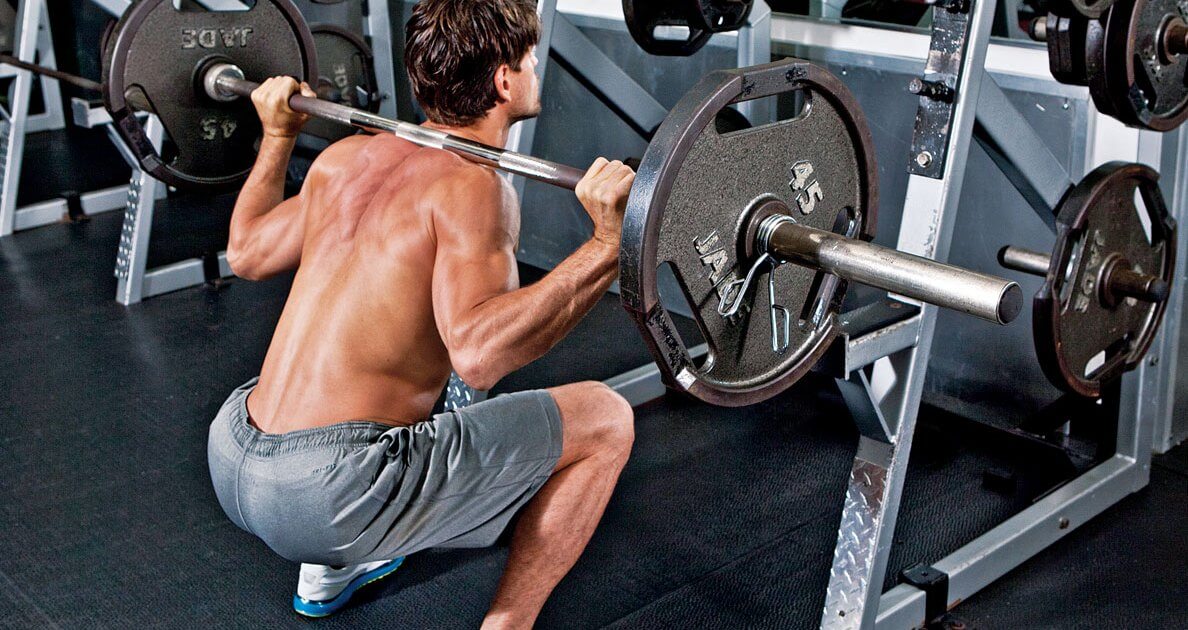
The squat: the king of bodybuilding movements!

Apart from the involvement of the extensor muscles of the hip, knee, ankle, trunk and abdominal joints, the squat is very demanding on muscular and motor levels.
The specific posture adopted, the muscle recruitment, and the muscle contractions are similar to many sporting and everyday movements.
It engages the quadriceps, glutes (gluteus maximus, minimus and medius), spinal muscles (mainly lumbar), hamstrings, adductor magnus, adductor brevis, gracilis, adductor medius, triceps surae and abdominals.
Precautions: It is essential to avoid rounding your back, either due to weak spinal erectors caused by poor posture (torso too far forward) or excessive flexion (below horizontal), which leads to rounding of your lumbar region and risks a herniated disc! Also, be careful not to shift your body weight forward, as this can increase pressure on your knees.
The Slits: not just for women!

Popular with women for strengthening their glutes and thighs, lunges are suitable for anyone who wants to develop their glutes and thighs without using heavy weights (as in squats) because they only work one leg at a time. Furthermore, their execution requires good balance due to the narrow stance and foot position (front foot flat and back foot on the toes). The exercise is also more comfortable for the back because the torso bends less forward.
It engages the quadriceps, glutes (gluteus maximus, minimus and medius), spinal muscles (mainly lumbar), hamstrings, adductor magnus, adductor brevis, gracilis, adductor medius, triceps surae and abdominals.
Precautions: Your back should always remain straight and never round. Also, be careful not to shift your body weight forward to avoid increasing pressure on your knees and keep your front knee above your ankle.
Leg extension: properly isolate your quadriceps!

The leg extension, by its position, bypasses the action of the rectus femoris (which is in a shortened position) and therefore fully engages the vastus medialis and vastus lateralis to perform the movement. This will allow you to further shape your lower thighs.
Caution: make sure to keep your buttocks firmly planted and pressed against the seat so as not to cheat the movement to the detriment of your back health!
Find me on Facebook for more sports information!
Find my live and online coaching packages in my online shop !

