



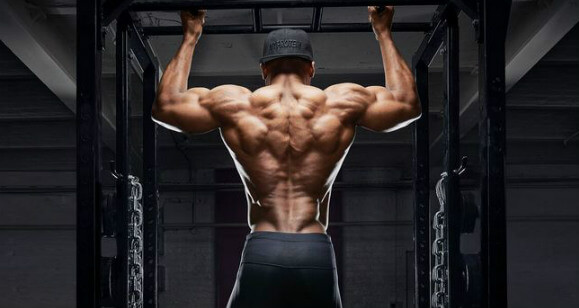
Perhaps one of the least targeted muscles for beginners or intermediate gym-goers, but just as important for building an athletic physique: the back! Often neglected by some gym-goers, it’s essential to pay particular attention to its training!
Indeed, in addition to its aesthetic role, the back plays a very important functional role!
Anatomical approach:
From a global perspective, the back extends from the pelvis to the head. This large body area is made up of numerous muscles located on different planes.
Among these, we distinguish the deep (hidden) musculature, the middle layer, and the superficial (visible) musculature.
Deep musculature, I will briefly mention these muscles since they will be fully presented in a future article.
Here we find all the muscles that are not visible and that play a role in maintaining and articulating the spine, including:
– short muscles connecting the vertebrae together.
– long muscles called spinal or erector spinae (along the entire spine), which meet in the lower back “common sacro-lumbar mass” and extend to the base of the skull. They allow trunk extension, rotation and lateral flexion of the trunk.
On the middle plane, we find the superior and inferior posterior serratus muscles whose role is respectively inspiration, elevation of the ribs, and expiration and lowering of the ribs.
On a superficial level, we then find visible muscles:
– the latissimus dorsi
– the small circle
– the large circle
– the spiny undergrowth
Other muscles are also present but not visible: the rhomboid major and minor, the levator scapulae and supraspinatus, which are hidden by the trapezius muscle layer. Also present is the subscapularis on the anterior surface of the scapula.

Plastic approach:
With this in mind, I will only discuss the visible muscles:
– the latissimus dorsi: it is an adductor, retropulsor and internal rotator of the arm.
– the teres minor: it is an adductor and external rotator of the arm.
– the teres major: it is an adductor and internal rotator of the arm.
– the infraspinatus: it is an adductor and external rotator of the arm.
– The trapezius muscle: its upper portion allows for shrugging the shoulders (unilaterally/bilaterally), extending the head backward (bilaterally), and rotating and tilting the head (unilaterally). Its middle portion allows for drawing the scapula (shoulder blade) toward the spine and pulling the shoulder back. Its lower portion allows for lowering the shoulders and rotating the scapula (external rotation).
Therefore, for harmonious back development, it will be necessary to ensure excellent technical execution of each movement during training.
Training :
Overwhelmed by miracle methods and exercises, here’s a basic strength training session for your back:
Horizontal shot: 4 x 10, recovery 1’30.

Starting position: grasp the handle, palms facing each other, back straight, move buttocks back on the seat, place shoulders above pelvis, legs slightly bent and squeeze them.
Execution: Pull your elbows back and down, keeping them close to your chest until the handle touches your abs. During the pull, move your shoulders back and down. At the end of the movement: squeeze your shoulder blades together, pulling your shoulders back.
Breathing: inhale while pulling and exhale while releasing.
Neck pull: 4 x 10, recovery 1’30.

Starting position: Grip the bar with your hands wider than shoulder-width apart, palms facing forward, and elbows pointing forward. Tuck your knees under the pads, push your hips back, lean your torso forward, tighten your abs, and relax your shoulders.
Execution: Lower the bar to the back of your neck by lowering your shoulders and then pulling with your arms. Hold the low position, back tight, for 1 second, then raise your arms completely. Your elbows should move straight down.
Breathing: inhale while pulling and exhale while releasing.
Front pull or front pull (depending on your level): 4 x 10, recovery 1’30.
Traction:

Front drawing:


Starting position : Grip the bar with your hands wider than shoulder-width apart, palms facing forward, and elbows pointing forward. Tuck your knees under the pads, move your hips forward, position yourself under the bar, relax your shoulders, and tighten your abs.
Execution: Lean your torso slightly backward and lower the bar to chest level by dropping your shoulders and then pulling with your arms. Hold the bar against your chest, back tight and chest out, for 1 second, then fully raise your arms. Your elbows should drop straight down.
Breathing: inhale while pulling and exhale while releasing.
Shrugs: 4 x 10, recovery 1’30.

Starting position: standing with feet hip-width apart, legs slightly bent, glutes and abs engaged, and shoulders relaxed. Palms of hands facing the sides of thighs.
Execution: Raise your shoulders as high as possible using your trapezius muscles while maintaining a straight line. Slowly lower your shoulders as far as you can.
Breathing: inhale while going up and exhale while releasing!
This session is general and does not take into account the physical characteristics of each individual.
Find me on Facebook for more sports information!
Find my live and online coaching packages in my online shop !

